PODAMPETTA, Odisha: Thrice a week, before the sun warms the sand, the women of New Podampetta return to the houses they no longer inhabit. They carry flowers, turmeric, kumkum and oil lamps in plastic bags. The sea hisses behind them, louder than before, as if reminding them why they left.
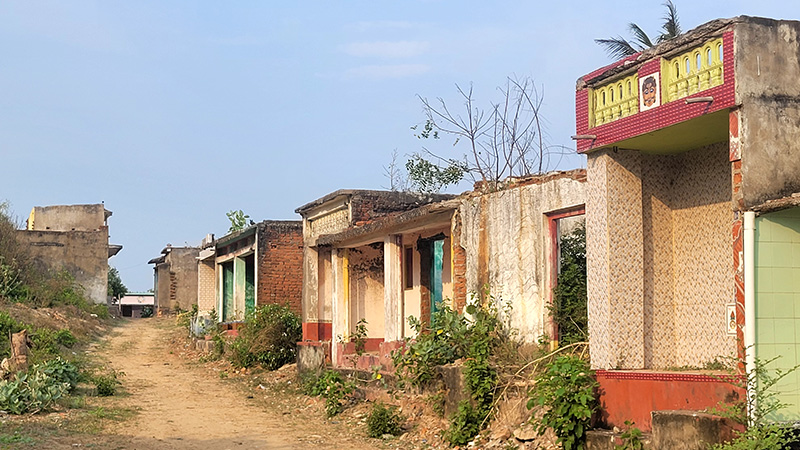
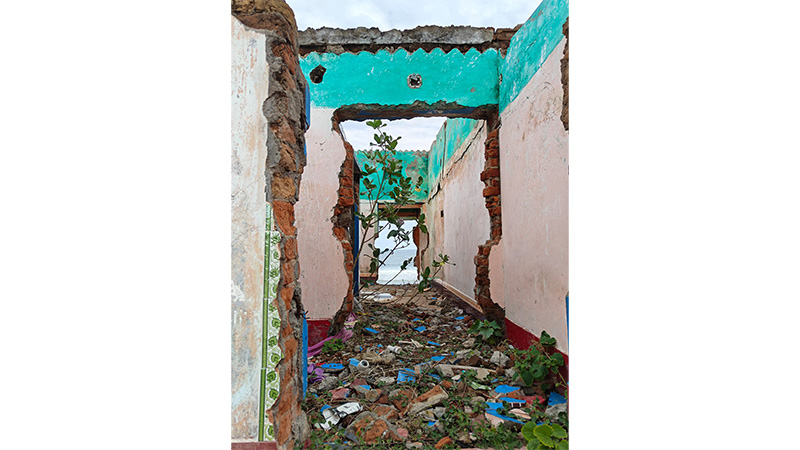
In Old Podampetta, empty houses wait like shrines, cracked walls holding more memories than people. Despite their ruin, the women clean the sanctums, light lamps, and chant some mantras to the gods.
“I come back here because our gods are here. We must honour them,” said one woman.
On festival days, they stay longer, cooking and cleaning as though no time has passed. For a few hours, normalcy returns: children run between courtyards, women fetch water, neighbours call across doorsteps. By nightfall, the lamps are out, doors locked, and the women make their way back to New Podampetta.
Coastal erosion has shaped life in Old Podampetta for decades. Even before Cyclone Phailin struck in 2013, mud homes near the shoreline were regularly inundated by the sea. Between 2005 and 2016, the shoreline moved closer to the road, shrinking from 211 metres to just 91 metres, proof of how quickly the sea advanced inland.
Residents said their houses had been eroded five times over, forcing them to rebuild each time. Eventually, about 100 households were relocated to government land, now called Siddhant Nagar. But before they could settle there, Cyclone Phailin made landfall, destroying what remained of Old Podampetta, forcing more families to leave
The relocation didn’t happen all at once. It unfolded in fragments. Some families were shifted to a planned resettlement site called New Podampetta in 2014, others to Siddhant Nagar in 2011, and a few—those who received only one house under the Odisha Disaster Recovery Project (ODRP), a post-disaster housing scheme—remained in the original village, now called Kuntiaguda.
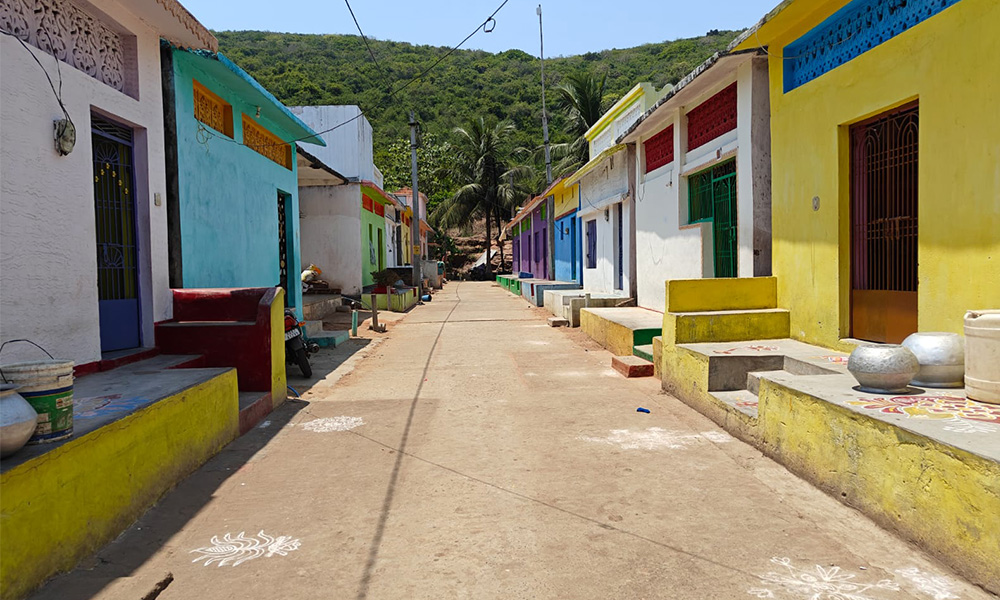
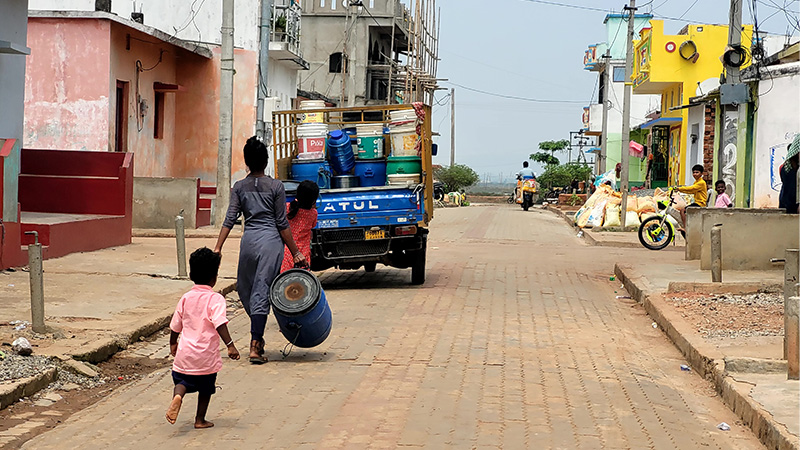
What was once a close-knit community is now spread across three settlements. The men still go out to sea together; the women still cook the same food, speak the same language, and celebrate the same festivals, but their shared afternoons, borrowed ingredients, and front-step conversations that once made these routines alive are gone.
Livelihoods, too, have suffered. Fishermen from Siddhant Nagar and Kuntiaguda must travel by foot or two-wheelers to New Podampetta to join crews, since traders come only there to buy fish. The distance adds fuel costs and uncertainty to already precarious work.
“We can’t even open shops,” said one resident. There aren’t enough people here to buy. If everyone were together, wouldn’t it be better?”
Migration has long been part of life in Podampetta, especially during the fishing off-season, when men travelled to coastal towns such as Kerala, Kanniyakumari, Chennai, Mumbai, and Visakhapatnam, or to cities like Bengaluru and Hyderabad for daily-wage work. Relocation, however, has altered this pattern.
What was once seasonal has increasingly become a compulsion. In settlements like Siddhant Nagar, the distance from the sea, lack of fishing infrastructure like jetty or harbour, and government fishing bans during turtle nesting season (February–May) make earning a living difficult. The annual compensation of ₹15,000 is insufficient for months without income, pushing many men to migrate for longer periods to work on large trawlers, often leaving women, children, and the elderly behind, dependent on remittances. While families try to return when they can, rising costs increasingly make even short homecomings difficult, even as ties to Old Podampetta endure.
Relocation began with government warnings that the ocean had “eaten away” houses near the coast. Officials advised the community to move 5 km inland, but the people of Podampetta, however, resisted. For their livelihoods, they needed to remain close to the sea.
So the village elders proposed an alternative site, on unused forest land just half a kilometre inland—far enough from the immediate threat of erosion, but close enough to sustain their livelihood. Because the relocation was framed as voluntary and community-driven, the state accepted the decision. In this way, the community itself played a central role in choosing the site for New Podampetta, negotiating between state directives and their own livelihood needs.
In practice, however, relocation was uneven. While most agree it was inevitable, only a few were happy about leaving their village. Ridhima’s (name changed) family, though allotted a house in New Podampetta, still lives part-time in the old village.
“People ask why we stay in this abandoned village? I tell them how rich people build their houses in secluded areas, so we have kept our house in this secluded village.” During the day, her family runs an internet café and kirana grocery shop in New Podampetta, but at night they walk along the beach to sleep in their old home.
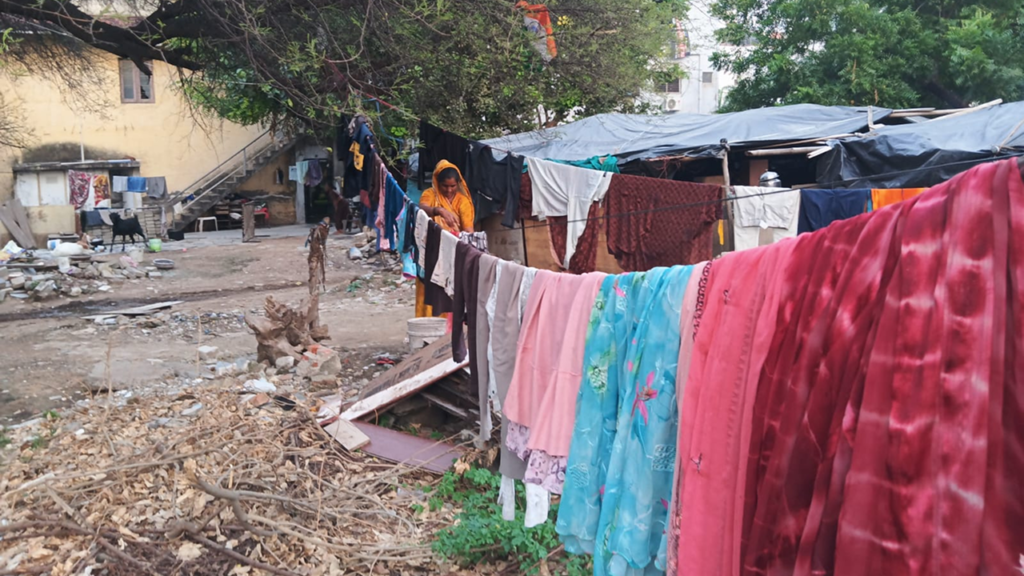
Unlike Ridhima’s family, about 20 families in Kuntiaguda remain there not by choice and claim to be “trapped” despite wanting to reunite with their families in New Podampetta. They were allocated only one house under the ODRP which defined a household narrowly as a husband, wife and their unmarried children, excluding married sons and their families living in the same home. As a result, a single unit, typically 600-700 sq.ft, often had to accommodate multiple related families. “They keep asking for land here, but there is no more left,” said a resident of New Podampetta.
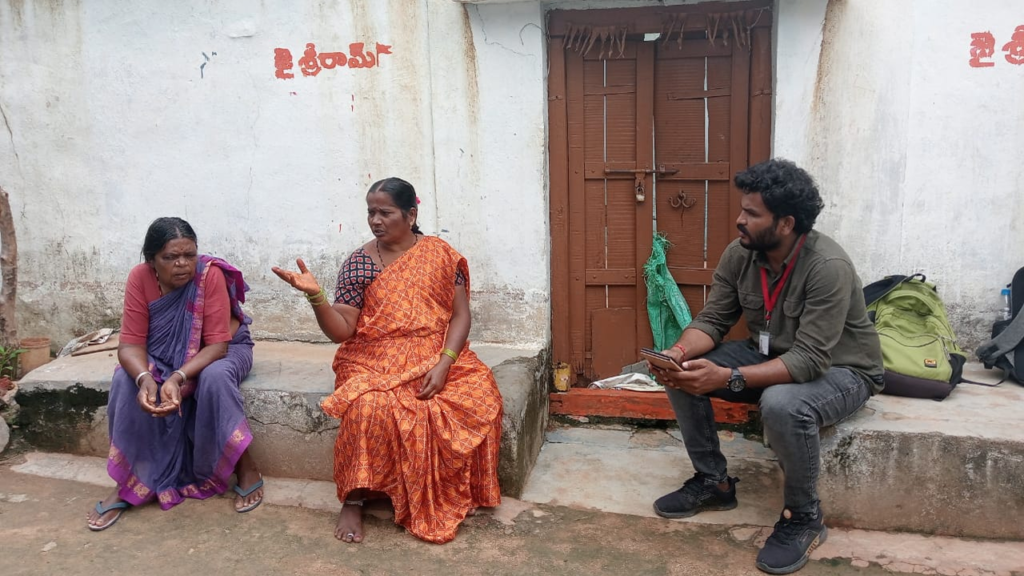
Many claim their names were deliberately erased from the beneficiary lists drawn up by village elders. When I met them, they crowded around, sharing their names and fathers’ names, hoping to be recognised by the people of New Podampetta. They allege that, for political reasons, houses meant for them were given away to families more favoured by local leaders.
“We didn’t get a house here. Half the family is here, half there,” one of the villagers said. These split households reveal a deeper policy gap— one that ignored extended family units, kinship ties, or shared livelihoods.
For many, returning to old Podampetta helps sustain a connection to their life and memories. Acts like visiting temples, cleaning homes, and gathering for rituals keep memory and belonging alive.
“Yes, we go daily to Old Podampetta. There are gods and demons there; we go there to do pujas,” said one woman. “On festival days, we clean the house and maintain it as if no time has passed.” These visits aren’t just about worship—they are a way to remain anchored to the place they once lived
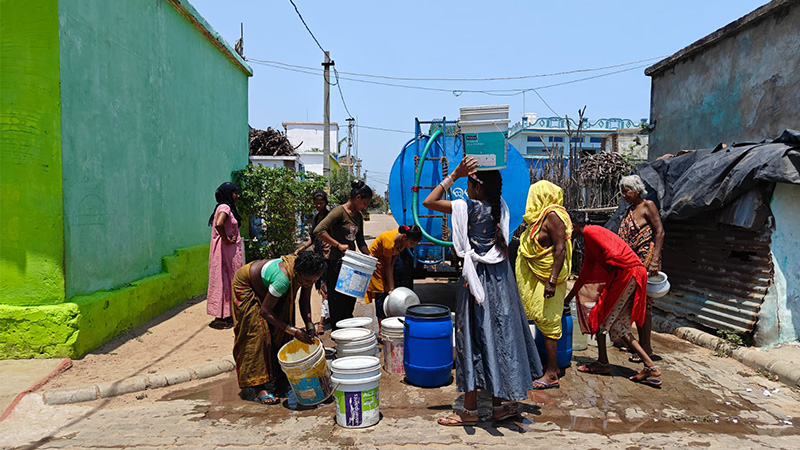
Women spoke vividly of how relocation disrupted their everyday rhythms. In Old Podampetta, they fetched water together from nearby handpumps near the Bateshwar temple, a shared routine that doubled as time for conversation and companionship. In New Podampetta, the unreliable piped water supply has made this ritual both harder and lonelier. Despite relocation policies and the changing coastline, many continue to return to Old Podampetta because it still feels like home—where their gods are, where their memories live.
Podampetta is not alone. In Ramayapatna, families maintain their ODRP houses as backup shelters, used during storms or lean fishing months. Some move in temporarily to maintain them, or lend them rent-free to kin. In Bagapatia, relocated residents still return to Satabhaya to fish, collect crabs, or manage prawn farms, staying for days in ancestral homes that still stand.
These forms of translocality—stretching their lives across more than one place—are quiet acts of adaptation. In refusing to live within fixed geographies, they carry their memories, rituals, and relationships between homes. Relocation, it seems, is rarely complete and never clean.
WHAT RELOCATION MISSES
Displacement fractures more than rooflines. It splits families, breaks routines and livelihoods, and severs the invisible threads that bind communities together. The 20 families “trapped” in Kuntiaguda didn’t choose to stay; they are the outcome of a planning approach that counted housing units but overlooked kinship networks and its critical role in social resilience.
Podampetta’s story offers important lessons for how relocation should be designed. First, communities must be relocated together to prevent social fragmentation that weakens networks of care and livelihood support. Second, site selection should prioritise livelihood continuity ; families in Siddhant Nagar lost fishing opportunities because of distance from the coast, forcing them to travel long distances to sustain their work. Third, cultural and spiritual ties must be recognised—people need support to safely move their deities, not leave them behind. Finally, beneficiary identification must be transparent and government-monitored to prevent exclusion through local politics.
As India’s coastline continues to change, millions will have to move. The question isn’t whether relocation works, but whether it works for the people being relocated. The choice is simple: plan for how people actually live or watch them improvise around policies that ignore half their lives. Until then, the women of Podampetta will keep returning to their old houses until someone builds policies that understand why they need to.
Edited by Sofia Juliet Rajan
Satwiki Adla is an external consultant at IIHS, studying how climate change affects coastal communities in Odisha, with a focus on exploring the grief and loss displaced people experience.
This analysis has been co-published with CLAPs