
Cyclone that climbed the hills: Titli’s unseen footprint in Odisha
- Lata Biswal and Sheetal Patil

- 8 hours ago
- 6 min read
Nearly a decade after the cyclone swept through the hills of Gajapati district, stripping soil from the farm steps and washing away spring sources, its impact is still felt in every home, with more members migrating for work

Lata Biswal

Sheetal Patil

National Disaster Response Force personnel engaged in relief efforts during Cyclone Titli in 2018 in Odisha. Pic Credit: NDRF
On 11 October 2018, tropical cyclone Titli made landfall between South Odisha and North Andhra Pradesh, near Palasa, with wind speeds of 150-165 kmph. Classified as a severe cyclonic storm by the India Meteorological Department (IMD), it brought torrential rain across Odisha for nearly four days. Gajapati district, about 55 km from the landfall site, recorded 296 mm of rainfall. Over 8,000 trees were uprooted, rivers swelled, and 18 people lost their lives.
According to Odisha’s Special Relief Commissioner’s report, seven blocks, 1,636 villages, 5.77 lakh people, 34,278 houses and 5.3 lakh livestock were affected, while 80,000 hectares of standing crops were destroyed. Roads, power and telephone lines, bridges, and schools were damaged.
Odisha has been a frontrunner in disaster management in India. The Odisha Disaster Management Authority was set up in 1999 as India’s first disaster management authority in India and preceded the National Disaster Management Authority of 2005. Until 2018, Odisha’s disaster management efforts focused mainly on coastal districts vulnerable to storm surges and tsunamis, building embankments and cyclone shelters along the coastline.
But hilly interiors like Gajapati had limited preparedness. Despite cyclone Hudhud crossing the district in 2014, early warning systems and shelters were absent here. “We were not warned about the cyclone’s severity.”
A TRADITION UPROOTED
Rayagada block, in south-eastern Gajapati, lies in the Eastern Ghats—rugged, forested and home to the Mahendragiri hill, source of the Mahendratanaya river and numerous natural springs. Its 40,000-odd inhabitants include the Saura, a Particularly Vulnerable Tribal Group (PVTG), with deep roots in forest-based livelihoods.

Maize grown on hill slopes in Amarsingi village. Pic Credit: Sheetal Patil
For generations, the Saura have practised shifting cultivation, rainfed, terrace-based farming involving meticulous clearing, seed-ball preparation, and all-day labour. Alongside millets and vegetables, they grow banana, papaya, and mango, collect forest produce such as tamarind and mahua, and rear livestock for manure, draught, and sale during festivals. This system, rooted in local ecology, forms the backbone of both economy and culture in these hills.
Titli’s fury reshaped these hills. Landslides and floods stripped soil from the farm steps. “Only boulders were left and there was no soil. How could people have done farming on the hills?” recalled a woman in her thirties from Baunsagan. For the next two to three years, shifting cultivation became really difficult. Even when farmers tried to resume, they found soil fertility depleted, nutrients washed away, weeds taking over fields, and yields diminishing.
“It’s been 5–8 years since the cyclone. The soil has lost nutrients. Even when we weed, the growth comes back faster. Earlier, we needed to weed only once and crops grew well,” said a community resource person from Ukarasingi village.
The hydrology of the hills changed too. Landslides washed away spring sources, drastically reducing water flow. In Amarsingi village, residents said water availability had dropped from 90% to 10%. Kantagan village lost its drinking and irrigation sources entirely. In Bausagan, a perennial river now runs dry for much of the year. “The cyclone eroded the riverbed and shifted its banks upwards. Now, it no longer flows year-round.”
In the aftermath of the cyclone, many farmers moved away from shifting cultivation to cashew plantations. A 2024 study by Gram Vikas found that around 80% of households in selected gram panchayats of Rayagada block, such as Koinpur, Kerandi and Laxmipur, now grow cashew due to its low maintenance and high profitability. Farmers earn between ₹50,000 and ₹3 lakh per season, which lasts for nearly three years from sowing to harvest. Yet, Titli had destroyed up to 85% of cashew orchards in Koinpur, drastically reducing incomes.
Cashews also bring ecological risks. Farmers say cashew trees trap heat, increasing local temperatures. Large tracts of forest are cleared for new plantations, and the trees are highly vulnerable to torrential rain, which causes rot and yield loss.
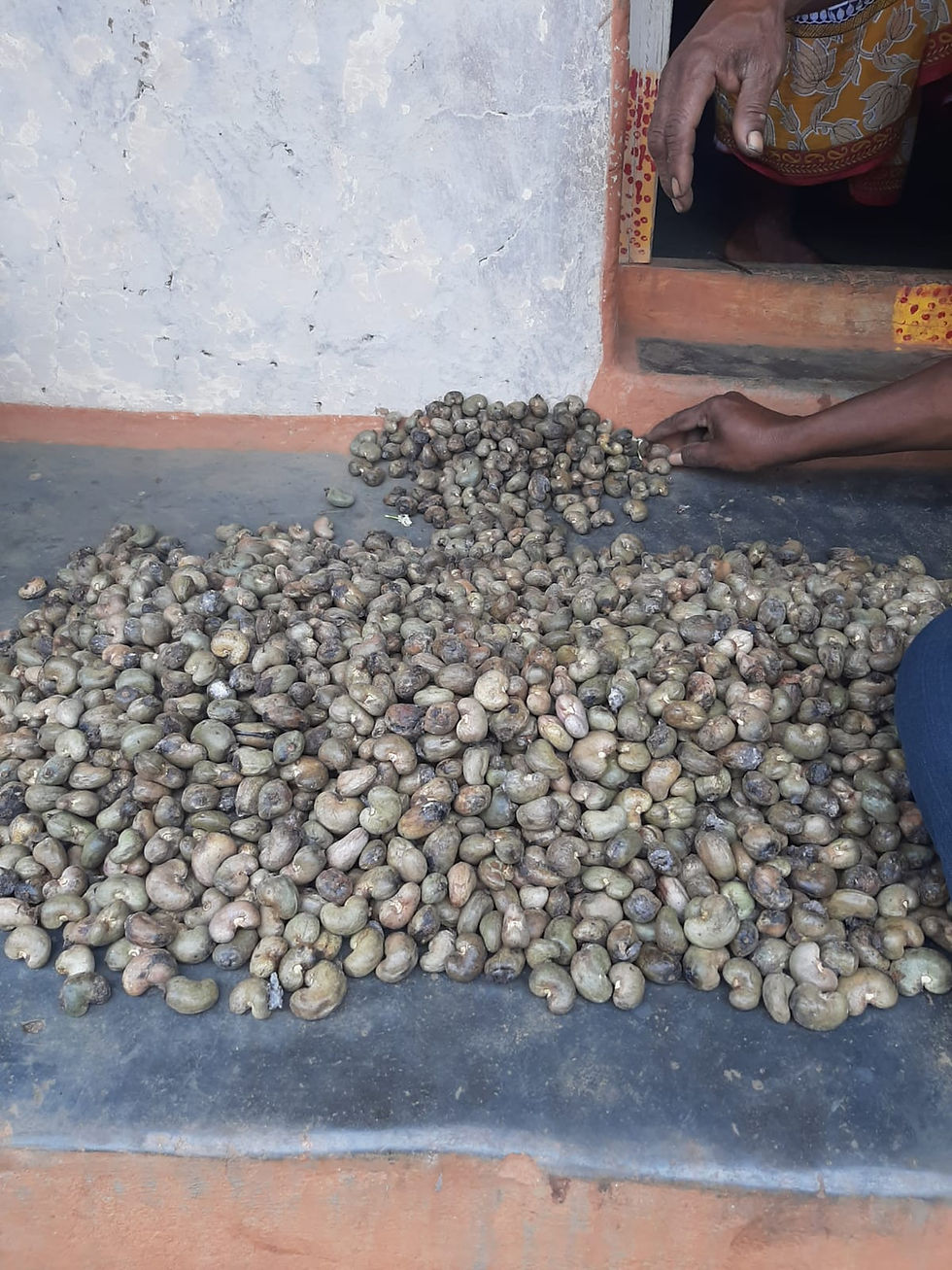
A farmer separates rotten cashews in Tili village. Pic Credit: Lata Biswal
SHRINKING FORESTS, RISING HEAT
Around 23% of Rayagada block remains under forest cover, but Titli left deep scars. In Teraba village, a women’s self-help group once earned Rs. 20,000 a month from broom grass cultivation, until their fields were washed away. Non-timber forest products (NTFPs) such as tubers, roots, and wild fruits, which sustained both diets and incomes, became scarce.
Landslides destroyed wildlife habitats, pushing monkeys and wild boars into farmlands where they ravaged crops. “The forest was damaged entirely… trees got uprooted. We feel more heat now; the shade of dense forests used to give us relief,” recalled villagers in Teraba.
LABOUR MIGRATION: STRATEGY AND RESISTANCE
According to Gram Vikas and Centre for Migration and Inclusive Development (CMID), nearly 45% of households in Rayagada block had at least one member migrate for work in the past decade, both within Odisha and beyond. For many, Titli’s devastation left no choice—three years without cultivation pushed them to seek work elsewhere.
Others chose to stay back, adapting shifting cultivation with horticulture to maintain livelihoods. Yet, water scarcity, declining soil fertility, poor yields, and a lack of interest among youth, are eroding this tradition.
Although the state sanctioned Rs. 2,770 crore for relief, promising work for horticulture and cashew farmers through the Odisha Livelihood Mission and Mahatma Gandhi National Rural Employment Guarantee Act (MGNREGA), climate extremes continue to force tribal families toward migration or wage labour.
Gram Vikas, in partnership with the Government of Odisha and NGO Goonj, led relief and rehabilitation in cyclone Titli-affected areas. The project restored piped water supply systems in 35 villages, generated 9,226 workdays for 691 families across 26 villages, restored 841.31 acres of land, repaired roads and cleaned drinking water sources in 66 villages. It also distributed 4,143 cloth-for-work kits, where individuals received clothes in exchange for their labour in the rehabilitation work.
Post Titli, communities have built informal disaster protocols. From September each year, Badamasingi village conducts awareness campaigns to protect crops and livestock. Migrant workers reassess travel plans, and residents of kachha houses move to neighbours’ pucca homes during cyclonic alerts.

Interactions with residents of Nuasahi village. Pic Credit: Lata Biswal
To strengthen tribal rights and forest-based livelihoods, the Odisha government launched Mo Jungle Jami Yojana in 2023 under the Forest Rights Act (2006). The initiative aims to secure land ownership for PVTGs and forest-dependent communities, ensuring access to resources, livelihood security, and food sovereignty.
By recognising both individual and community rights, it enables families to cultivate forest land, access waterbodies, and manage forests collectively—preserving habitat, income and traditional ecological wisdom. However, the scheme’s progress has been slow.
Only a fraction of individual, community, and community forest resource claims have been settled so far. This gap between policy intent and on-ground implementation limits the scheme’s potential to strengthen land tenure and resilience in cyclone-affected hill regions like Gajapati.
Communities are clear about protecting reserved forests, avoiding cultivation there, but challenges on revenue lands where shifting cultivation continues. At times, afforestation drives under MGNREGA overlap with cultivation areas, creating tensions. Still, the scheme marks an important step toward aligning state policy with indigenous knowledge and community-led conservation.
REIMAGINING RESILIENCE IN THE HILLS
Titli left deep, lasting impacts—damaging soil, stripping forests, threatening water security, and forcing migration. Yet, rebuilding is possible through collaboration and innovation. Village Development Committees, Self-Help Groups, Farmer Producer Organisations, and Gram Panchayats can work together to map water availability, manage summer scarcity, and lead afforestation with native species.
Mobilising labour under MGNREGA for soil conservation and water management can create durable community assets. Policy must also value tribal ecological knowledge, making shifting cultivation more sustainable while expanding horticulture to diversify income.
Temporary livelihood safety nets, such as cash-for-work activities like debris removal and village clean-up, can support families in post-cyclone recovery, as seen in UNDP’s initiative following the 2014 Cyclone Ian when in Ha’apai. But these cannot be substitutes for long-term recovery and place-based resilience building.
Resilience in Rayagada’s hills means blending tradition with innovation—protecting culture and livelihoods while preparing communities for an increasingly unpredictable climate.
Edited by Sofia Juliet Rajan
Lata Biswal is an external consultant at IIHS, with a background in Geography and GIS. Her research interests include understanding migration dynamics, climate adaptive livelihoods, role of village institutions in grassroot governance at multiple sites of rural Odisha.
Sheetal Patil is a Lead Researcher at Indian Institute for Human Settlements. Her research is focused on agroecology, climate change adaptation, and smallholder resilience in India.
This analysis has been co-published with CLAPs


Comments