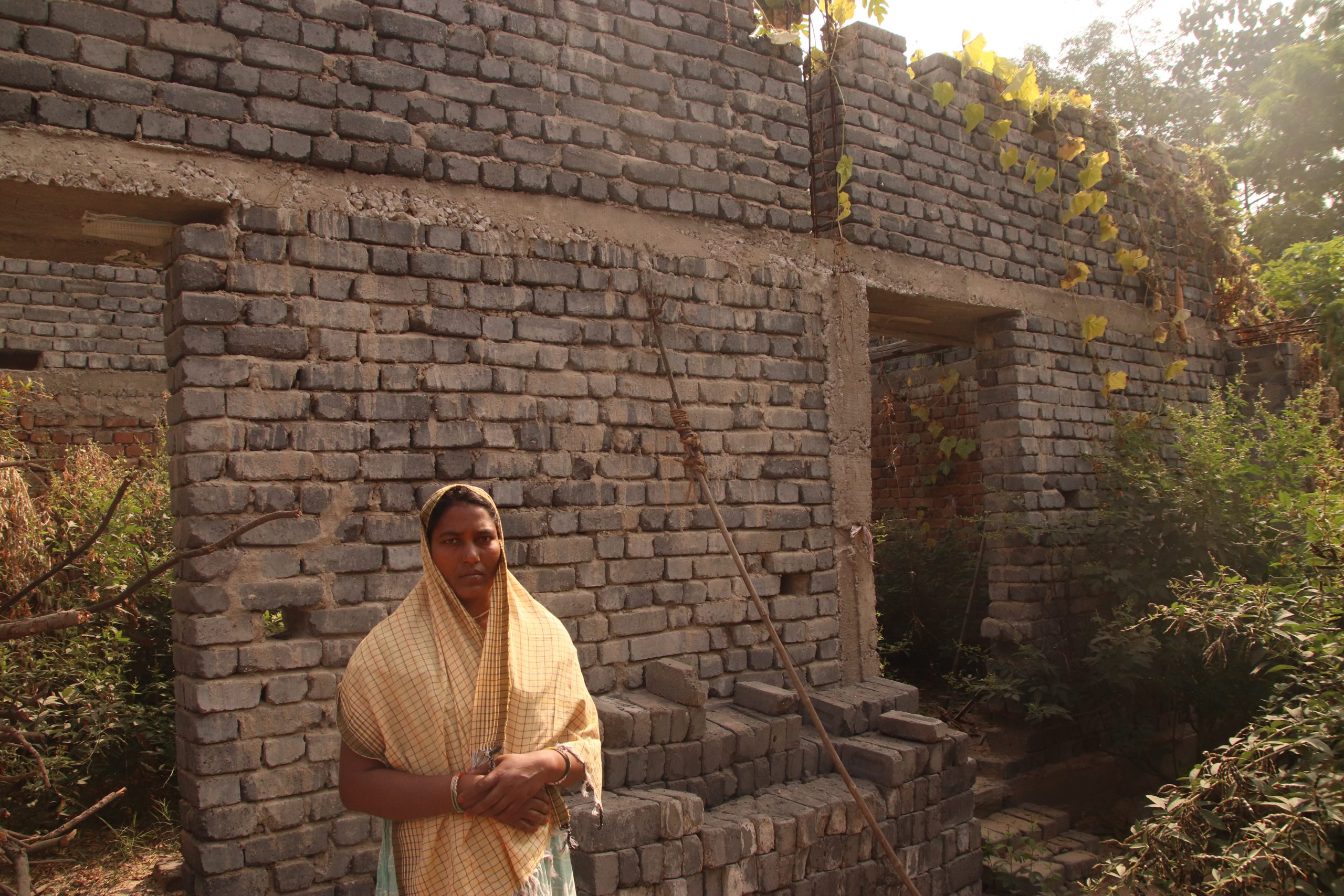
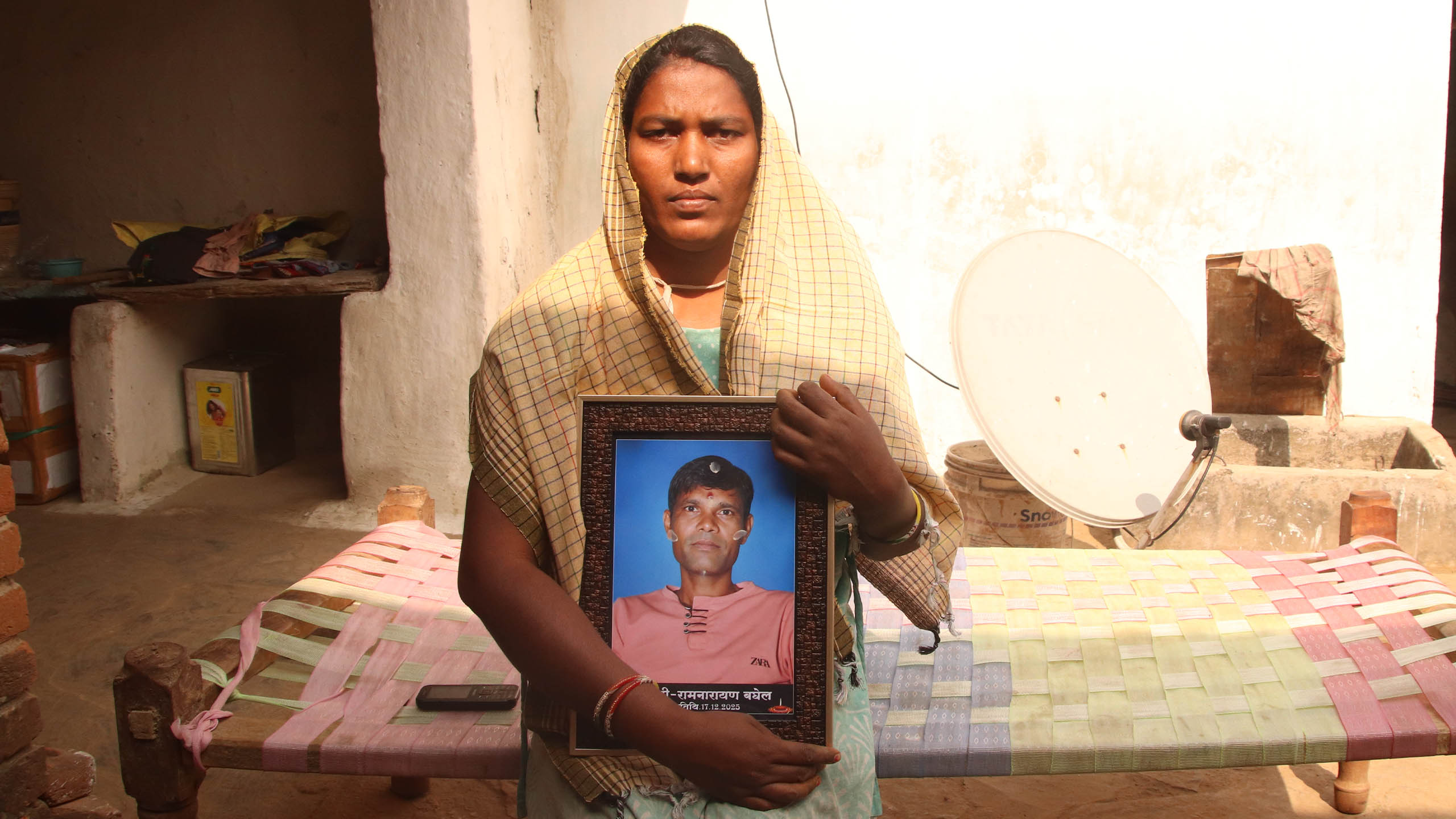
KARHI, Chhattisgarh: When Ramnarayan Baghel (40) migrated from his village in Chhattisgarh to Kerala’s Palakkad district, about 2000 kms away, his need was urgent yet modest : to put a roof on his family’s half built house. Today, that house remains open to the sky, its bare brick walls marking a dream left incomplete after Baghel was lynched by a mob in the southern state.
In Karhi, Baghel’s family has not seen the videos of the December 17 attack on Ramnarayan that have since gone viral on social media platforms. The family does not own a television or smartphone, their only communication device is a basic keypad phone on which Ramnarayan had called home to say he had reached safely. That was on December 13, a day after he reached Palakkad. He also spoke to his wife about the cramped living conditions and navigating an alien land and its language.
Five days later, on December 18, the keypad phone rang again. This time, it was the police informing the family of Ramnarayan’s death.
A month later, work at his unfinished house is yet to begin. Unused construction material is piled alongside a small mound of sand outside the partially constructed house. The space the family had kept for a verandah is covered with weed and shoots of grass sprouting from the earth.
The family – Ramnarayan’s wife, children and mother – undertook the house construction under Pradhan Mantri Awas Yojana but stopped work on it about four months ago after they ran out of funds.
“We needed more money for the roof and that is when he decided to go to Kerala. I had to accompany him as well so that both of us could work, earn and come back but there wasn’t any work suitable for me, so I stayed back,” said Lalita, Ramnarayan’s wife, as she sat on a charpoy at Ramrayan’s cousin’s house, across the lane where their house is being constructed, a gamcha pulled over her head, pausing often as she spoke, still struggling to put her grief into words.
“He had never travelled so far for work, he had never left the state before,” she told The Migration Story.
Migrant workers have been attacked in recent months across several states, with the victims often being labelled as Bangaldeshi or simply for not speaking the local language of the destination state, local media reports show.
According to police investigations and video evidence in Ramnarayan’s case, he too was confronted by a group of local men on suspicion of theft and was questioned about his identity and referred to as a Bangladeshi.
The Kerala government has announced a compensation of 30 lakh rupees for Ramnarayan’s family, the highest compensation announced in such an incident so far. Of this amount, his mother and wife will receive 5 lakh rupees each, and his two sons will receive 10 lakh rupees each.
“I will save the money to educate the children, so they can study well and find a job. I don’t want them to toil for work,” Lalita said, adding, “money does not compensate for the loss.”
The family said they may use the money to get their mortgaged land back but hadn’t decided if they would use it to build the roof.
A MORTGAGED LAND AND AN UNFINISHED ROOF
Ramnarayan lost his father when he was five and was raised by his mother, who was the first to learn about his death.
“He spent his childhood without his father and saw his mother work very hard to make ends meet. He wanted to build a house for his family and always said he did not want his sons to grow up without their father the way he did,” said his cousin Sashikant Baghel.
Married for 11 years and father of two children aged 10 and nine, Ramnarayan’s wish to build a house was long overdue. He had patiently watched his cousins and relatives build their homes, hoping he would be able to do so himself one day. So when he finally started work on his house a year and a half ago under the Pradhan Mantri Awas Yojana (PMAY) scheme, the family’s joy knew no bounds.
However, the PMAY payout of 1.3 lakh rupees proved to be insufficient for the house Ramanarayan and his family were building.
“The money ran out in just laying the foundation and constructing the walls. The bricks come from far and we have to spend a hefty sum on the transportation as well,” Lalita said.
To complete the construction, the family first mortgaged its land, measuring less than an acre, for 60,000 rupees in an arrangement that allows the moneylender to cultivate the land and keep the produce. The land would return to the family when the money is repaid.
The family of five was dependent on Ramnarayan’s wages, who migrated to nearby cities looking for daily wage work. In Raipur, about 250 km from Karhi, he earned Rs 300 a day. Wages elsewhere were higher, he was told in this village of 3000 people, with many youth migrating to Delhi, Jammu & Kashmir and Punjab. He learnt about workers in Delhi making as much as 500 rupees a day and that in Kerala, contractors were paying up to 850 rupees for work at construction sites.
The wage rates in Kerala were compelling for a group of eight in Karhi, including Ramanayaran, to leave for the state to look for work in December 2025, like tens of thousands of people from across several states heading to the southern coastal state, which has in recent years emerged as a great caste leveller, drawing migrants for both wages and dignity.
A study, Exploring the Drivers of Long Distance Labour Migration to Kerala by Centre for Socio-Economic and Environmental Studies (CSES) indicates that Kerala over the years has witnessed an increase in in-migration to the state for various reasons like better wages, safety of women workers, rapid urbanisation, and better opportunities for skill development. The state has an estimated 3.5 million interstate migrant population.
While the state has witnessed migration from the neighbouring southern states since 1950s, migration from northern states gained momentum in early 1990s with the emergence of Kanjikode industrial hub in Palakkad district of the state.
Ramnarayan’s cousin Sashikant was the first who migrated to Kerala from the village.
“I had earlier worked in Delhi and was sent to Kerala by the company I worked for. The pay was better and I agreed. We needed more people for work and I asked my cousins and other people in the village,” he said.
Ramnarayan decided to follow.
The journey itself was long. The nearest major railway connection from Karhi is nearly 40 kilometres away. Ramnarayan travelled from there on the Champa–Kochivelly Express to Thiruvananthapuram, and then undertook a road journey of seven to eight hours to reach Palakkad district – all in the hope of completing the construction of his house.
“He kept saying once the roof is done, things will become easier,” Lalita said. “He wanted the land back and the house completed. That was the plan.”
THE ‘OTHER’
In the past two months alone, media reports highlighted incidents from various states : a migrant from Goghat attacked in Odisha for speaking Bengali, a migrant from Jharkhand attacked in Bengaluru for being falsely identified as Bangladeshi national, two migrants were attacked and killed in Punjab and Maharashtra and other incidents reported from Raipur, Coimbatore and Chikkamagaluru.
But there is no official consolidated data on the exact number of such incidents in the country.
The Migration Story reached out to the office of Ashutosh Pednekar, Joint Secretary & Director General (Labour Welfare), Ministry of Labour & Employment, via phone and email and he is yet to respond.
In Kerala alone, five incidents of mob lynching have been reported in the state between 2016-2025, with one incident reported each in 2023, 2024 and 2025, as per information collated by migrants’ rights nonprofit Centre for Migration and Inclusive Development (CMID).
Recent attacks on migrants in Kerala point towards the ‘othering of migrants’ in the state due to the systemic absence of proper implementation of welfare schemes for the migrants on ground and the increasing dependency on the migrant population with a shifting demography in Kerala, said experts.
“There have been social security schemes for the migrants but they are defunct when it comes to ground implementation. Second, the migrant workers in Kerala are called guest workers which is a reminder that they are guests and do not belong here. This leads to othering,” said Benoy Peter, Executive Director at CMID.
He further emphasized on the changing demography in the state. “There is a huge demographic shift in Kerala with a higher older population than the younger generation and a lot of our work in the state depends on the migrants. But most of them are locally called bhai, which here does not translate to brother but just used as a term to identify migrants from northern states, which also leads to othering,” he added.
The Migration Story reached out to the office of Kerala’s Labour Commissioner Safna Nazarudeen, who is yet to respond.
‘NO WORK HERE’
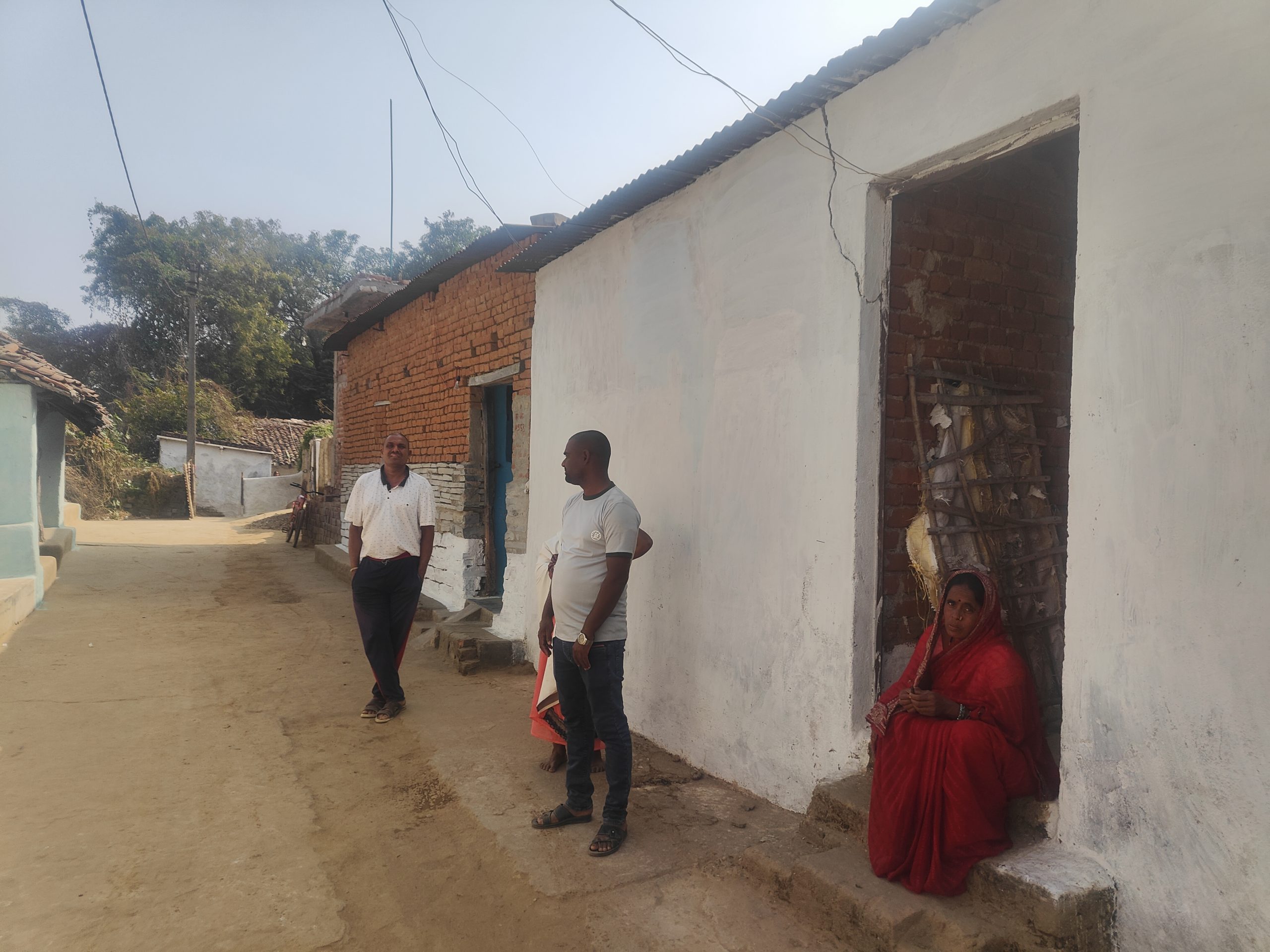
Karhi village is located in Sakti district of Chhattisgarh, and most families belong to Dalit and Other Backward Caste communities. Agriculture is the mainstay profession, but landholdings are small and rainfed agriculture does not sustain households throughout the year.
“Most of the land that we own is attached to our houses, in our own backyards,” said Sashikant, adding that most families own less than an acre of land.
“We mostly grow paddy which is sold in the mandi. There isn’t any irrigation, so apart from monsoon, other seasons are a bit difficult. A few families with very small land holdings are also involved in contract farming,” he said, explaining why people have been migrating from the village for years, in several cases both husband and wife migrating leaving their children with the family’s elders.
“There is little work locally outside the agricultural season. Young men migrate out in groups, usually to brick kilns or construction sites,” he said.
Which is why Ramanarayan’s death will not have any impact on villagers on their decision to migrate, locals here said.
“Just because of one incident, we can not blame the entire state. We also received support from local people when we needed it. And the wage helps us support our families at home. I don’t think we wish to leave Kerala,” Sashikant said.
A few metres away from Ramnarayan’s house in Karhi, a dimly lit thatched house shelters a bed-ridden woman, Samarin Baghel, in her early seventies. Her son Ranjit, a daily wage worker, also migrated to Kerala with Ramnarayan.
Samarin lives with her four grandchildren. Ranjit’s wife died after a prolonged illness.
“My mother is bedridden, my father and wife passed away and I have four children to raise. You feel scared wherever you go away from home. But what choice do we have? If we stay back, there is no work,” he said about migrating to Kerala.
He was accompanied by his youngest son aged 10.
“People don’t go far because they want to. They go because they have to,” he said.
Aishwarya Mohanty is Special Correspondent with The Migration Story